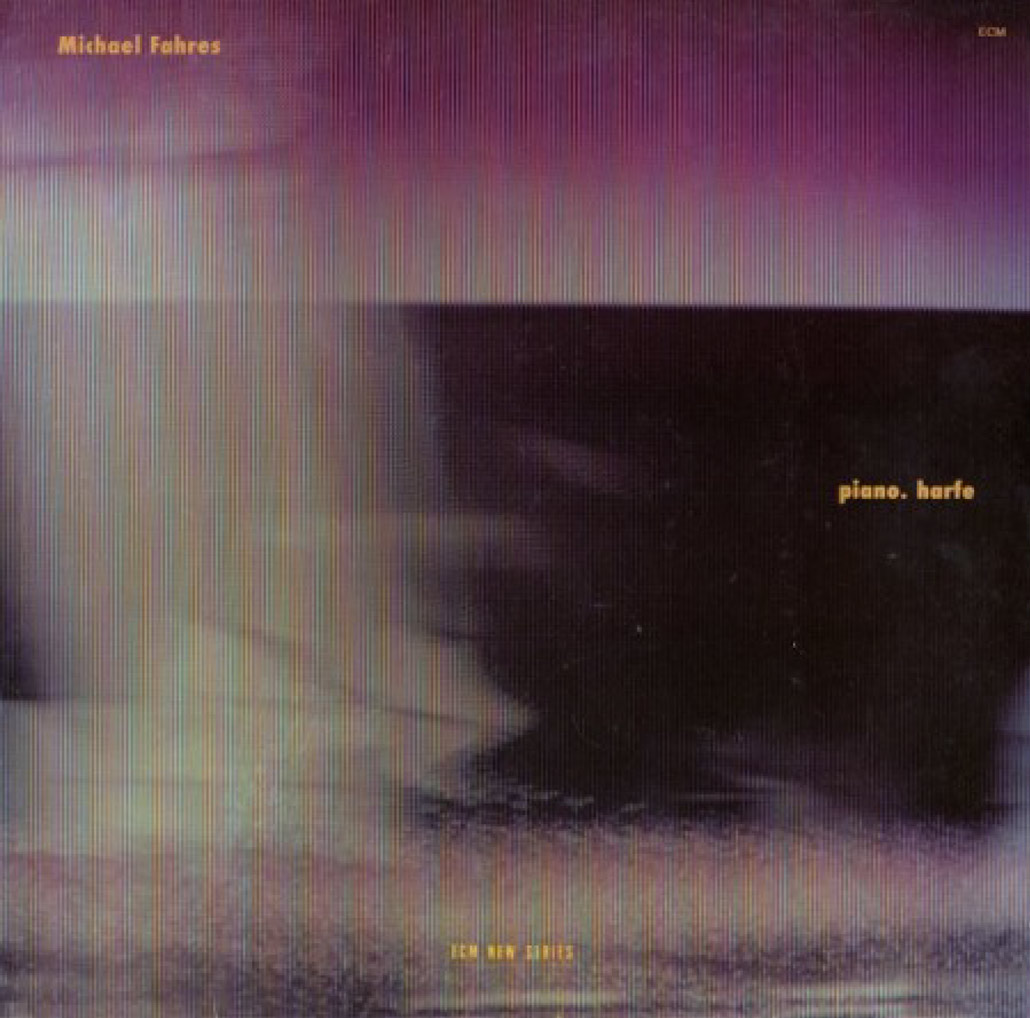
Harfe
1980 (open)
Electroinstrumental music for harp solo, electronics and magnetic field
The composition ‘Harfe’ is a further development of ‘Piano’. In ‘Piano’ I tried for the first time to scan a string with a coil. I would like to develop the work on this idea further. Coils were attached to different strings and controlled with a sequencer. This setup is to be refined. Hum and feedback problems would have to be solved. A suitable suspension system for the coils and the mics should be developed.
The second problem of ‘Harfe’ is the conception of a live delay system in which the delay times are variable. With ‘Minimal’, the amount of noise from the loops is so great that a new solution should be found. The use of a digital delay unit would be the best. The information about this would have to be worked out. Perhaps systems can be made with the microprocessors available at ‘Steim’. Here, too, I need the support of ‘Steim’. Some problems will of course arise during the creation of the composition. I cannot give an opinion on this at the moment.
In my composition ‘Piano’ I had tried to develop a style of composition which I called ‘ecological music’. The composition ‘Harfe’ develops this idea technically and musically. The ecological music deals with the relationship between the specific sound character of the harp (microstructure) and the definitive compositional form of the composition (macrostructure). The sound of the harp, i.e. the primary acoustic properties, contains information, e.g. overtone series, different volume ratios of the overtones to each other, which should influence and shape the finite form of the piece.
The electronics clarify the acoustic information, they examine and ‘magnify’ it, as if seen with a magnifying glass. The 8 bass strings of the harp (metal strings) are made to resonate by a computer using a terminal via 8 coils with magnetic fields. These resonances can affect the harp strings in two different ways:
1. the voltages are below 16 Hertz, i.e. the harp is plucked automatically, tempered tuning (see part 1).
2. the tensions are above 16 Hertz, i.e. the harmonics of the harp strings become audible, untempered tuning.(see part 3)
The computer can generate or not generate the tension information at the moment of the game. The information itself is previously recorded on a diskette. They can no longer be changed live themselves. The flow of information can thus only be started or interrupted.
At the beginning of the composition, the harp is made to vibrate ‘naturally’ by a wind machine. This sound production corresponds to that of the Aeolian harp of antiquity, which Aiolos, the Greek god of the winds, played. This is a historical reminiscence of the computer game with the harp.