
Mobilodrom
1979 (open)
Installation
In the project ‘Mobilodrom’ I have tried to combine music and environment with musical means. On a mobile object (electric car) a microprocessor is installed, which controls a synthesizer by means of an interface hybrid. On the vehicle there are also environmental sensors installed (e.g. air pressure gauge), which can influence the software (program sequences) of the computer through a converter. This technical arrangement has the consequence that environmental influences compose a complete piece of music on the basis of a music program (basic composition) conceived by me. Furthermore, whale sounds and bell sounds are used in ‘Mobilodrom’, which refer musically to the environmental problems.
Translated text spoken by Michael during the presentation of Mobilodrom in the centre of the city of Utrecht:
“For all those people who don’t know what this is about, let me explain a little. We are trying to translate the environment of Utrecht into music. And up here on this rack, we have a number of sensors that are going to translate the environment.
The little windmill here measures the air pressure in Utrecht, those two blue boxes over there measure the movements around the car, and the silver box next to them measures the temperature, and the other silver box next to that one measures the light currently present in Utrecht.
In front we have a microphone. Through the microphone, the hardness around us is measured, as well as the pitch around us.
This means that if we start driving here now, the city of Utrecht will be translated into music. This piece is about the environment. And as you can see in the program, I’ve chosen two types of sound material for this piece: the sound of whales and the sound of bells.
Whales as a symbol of our time, showing that our environment is not being properly handled by our society. And the bell as a symbol of history. For example during the Middle Ages and Renaissance the bell served as a signal instrument for a village. When there was a storm, you would hear the bell, and the community was warned that there could be a problem.
As you can also see in the program, there is an organization mentioned — namely Greenpeace. And I’m really glad that Greenpeace took part in this piece, because Greenpeace is one of the few organizations actively working to put an end to the death of whales and the annual killing of 150,000 seals.
Furthermore, Greenpeace also stands against the dumping of radioactive waste into the sea, which has been happening over the past 25 years. And now, we can’t even be sure whether the fish we eat contains radioactive waste or not.
Alright, to show you that our sensors are working, we’ve programmed a small special software. First, we’ll demonstrate what the pitch detector does. The input is a tone scale, and when I now produce a high-pitched tone in the microphone, that scale will be played two octaves higher.
And if I now produce a low tone into the microphone, the scale will be played two or three octaves lower. This means that when we’re driving and you suddenly hear very high tones, it has something to do with the high-pitched sounds surrounding the car.
You’ll notice that when a very high tone enters the microphone, the sound suddenly becomes very high. If no sound comes in, it stays exactly at the same pitch.
Now I’ll try a very low tone scale. (Sounds) You just heard it again — it wasn’t very high, but suddenly the octave shifted one octave higher. Fantastic.
Alright, now we’ll demonstrate the loudness detector. (Sounds) As you can see, when I speak now, the pitch doesn’t change. (Sounds)
This is a very simple example showing that the loudness of the sound around the car is being measured.
When very irregular pauses appear, it means, for example, that when a bus suddenly drives by, the entire loudness of the composition changes because of that.
Alright, we’re going to start driving again now. Maybe you feel like coming along? You’re very welcome, otherwise, good bye.”
Twan Eikelenboom (Virtueel Platform) interviewd Darko Fritz
Which works from the early days of computer-generated art do you find interesting? Which works were considered ‘best practice’ in the 1960s and 1970s?
“Michael Fahres’ Mobilodrom was an electric car that drove through a city and collected information such as the volume and pitch of sounds from the environment, movement, air pressure, wind speed, light levels and other variables.
This data was translated in real time and used by a computer as parameters for a computer-generated score. The work was produced by STEIM in Amsterdam and premiered in Croatia during the 1979 Zagreb Music Biennale. You regularly see this type of work in contemporary visual art and media art exhibitions, but at the time it was only presented in a musical context.”
“During my research, I was very fortunate to find a recording of the Mobildrom (2 minutes in colour and with sound) in the archives of Croatian National Television, a video that the creators of the work themselves had never seen before. Because this work is time- and place-specific, this type of documentation is the best way to get an idea of the work. Unless, of course, the original work is still available.
In order to assign a true value judgement to these works, they actually need to be recreated. Until then, we can assess the work on the basis of descriptions and, if we are very lucky, audiovisual documentation.”
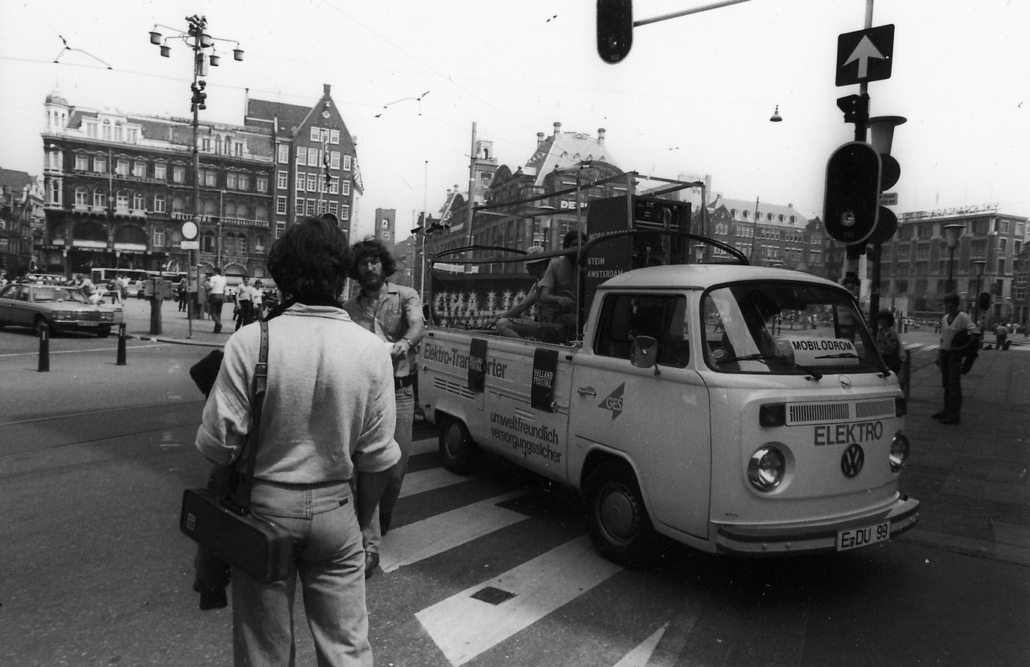
Mobilodrom in Amsterdam
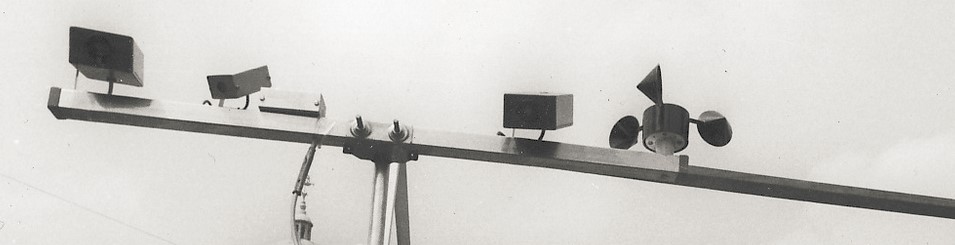
Sensors on the car in Amsterdam and Utrecht
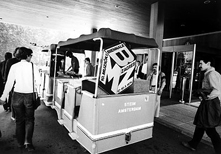
Mobilodrom in Zagreb
Excerpt from the TV broadcast MBZ Urbofest, editor Sedeta Midžić, HRT Croatian Radio Television, 1979 Mobilodrom first performed at the MBZ Music Biennale Zagreb, 1979, Urbofest (artistic director Nikša Gligo)

Exposition in Istanbul organised by Darko Fritz