
Trains
2007 (7′14″)
Electro Instrumental Music
‘Trains’, designed together with the visual artist Sigmund de Jong, deals exclusively with the 2 found empty rooms of the former gallery Rachel Haferkamp (Cologne Germany), i.e. what significance both rooms have and how they can be implemented with creative means.
The composition
The tape composition ‘Trains’ consists of sounds made by dolphins ‘clicktrains’, which were recorded in the dolphinarium in Duisburg, Germany. These increasing and decreasing strings of clicks (stringendo, tardando), which normally are 150,000 Hz high, had to be transposed into an audible maximum of 20,000Hz. The duration of these click trains was not changed.
‘Click trains’ are not only the dolphins way to communicate, but they are also used to measure the water temperature and to locate objects f.i. fish. This form of echolocation is essential for the orientation and therefore for the existence of these cetaceans.
This eight-channel composition in three parts, which could be heard in both the upper and lower rooms of the gallery, dealt with these clicks as follows:
First the clicks are made rhythmic by shifting the dynamics. Then they are segmented into different frequency ranges, f.i. by phase displacement. Click melodies are generated, sound surfaces are made audible because the sequence of the clicks (sometimes as much as 20 clicks per second) melts into one sound.
You either hear this process differently or synchronously the same in the two rooms that each have their own characteristic acoustic. Rhythmic accentuations and different timbres of clicks are created. The duration of the clicks sequence also compresses or widens the sound structures. This fills or empties the room; contractions are created. The gallery was transformed into a soundboard.
Especially for the exhibition of ‘Trains’ at the Galerie Rachel Haferkamp in Cologne, the Dutch artist Sigmund de Jong produced a black sound painting (de plaat) consisting of a thin aluminium plate. Under this plate the technician James Rubery attached a transducer that translates sound into motion and thus made the image vibrate. The clicktrains pulses of the dolphins were therefore very suitable to work with this technique. First, the small composition (duration of sound: 30″) was loaded into a chip. Now the visitor stood in front of the picture then he could start the sound by interrupting an infrared light, which was incorporated at the bottom of the picture. He then touched the record and felt the clicktrains.
The painting was later purchased by galerie Rachel Haferkamp.
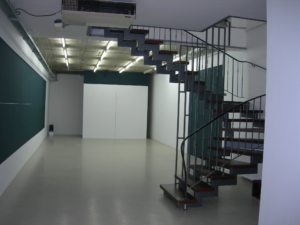
Ground floor of Gallerie Haferkamp after it had been ‘styled’ by Sigmund de Jong
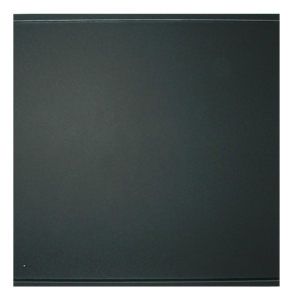
the black sound painting (de plaat) consisting of a thin aluminium plate.